
How to Get a Fire Going First Time, Every Time
How to Get a Fire Going First Time, Every Time
Knowing how to get a fire going first time is something most people think they should be able to do, but plenty of us have stood over a stove or fire pit watching the flame die out and wondering what went wrong. In most cases the problem is not the wood or the fireplace. It is the method – and specifically what happens in the first five to ten minutes.
Why most fires fail in the first few minutes
A fire needs three things: fuel, heat and oxygen. When one of those is missing or insufficient, the fire stalls. Most failed fires collapse in the early stages because the heat source – the firelighter – burns out before the kindling has reached ignition temperature.
When the firelighter goes out too soon, the kindling cools rapidly. Even if it was starting to catch, it often drops back. So you add another firelighter or more newspaper, and the cycle repeats. The root cause is almost always the same: the initial heat source did not burn for long enough.
Start with the right kindling
Kindling is the link between the firelighter and the logs. If the kindling is too thick, too damp or packed too tightly, it will not catch regardless of how good the firelighter is. Before anything else, sort the kindling.
Dry softwood splits work best – roughly pencil-thick to finger-thick. The wood needs to be genuinely dry, not just dry on the outside. Freshly cut or unseasoned wood holds moisture in the core. When that moisture turns to steam during heating, it absorbs energy and slows ignition.
Stack the kindling loosely above the firelighter with gaps between each piece. The gaps are deliberate – they let air flow through the stack. A tightly packed bundle smothers the flame instead of feeding it. Think of it less like a pile and more like a tiny log cabin above the firelighter.
Why your firelighter makes more difference than you think
Knowing how to get a fire going reliably comes down to one thing more than any other: the firelighter. A firelighter that burns for two minutes puts less heat into the kindling than one that burns for ten. That sounds obvious, but it is the single most overlooked variable in lighting a fire. Most people reach for whatever is cheapest, assume firelighters are all the same and then blame the wood when it does not catch.
The first few minutes of a fire are critical. The kindling needs to absorb enough heat to reach its own ignition temperature before the flame source disappears. Because of this, a longer-burning firelighter almost always produces a more reliable result – especially with slightly thicker kindling or in a stove where the air draw has not fully established yet.
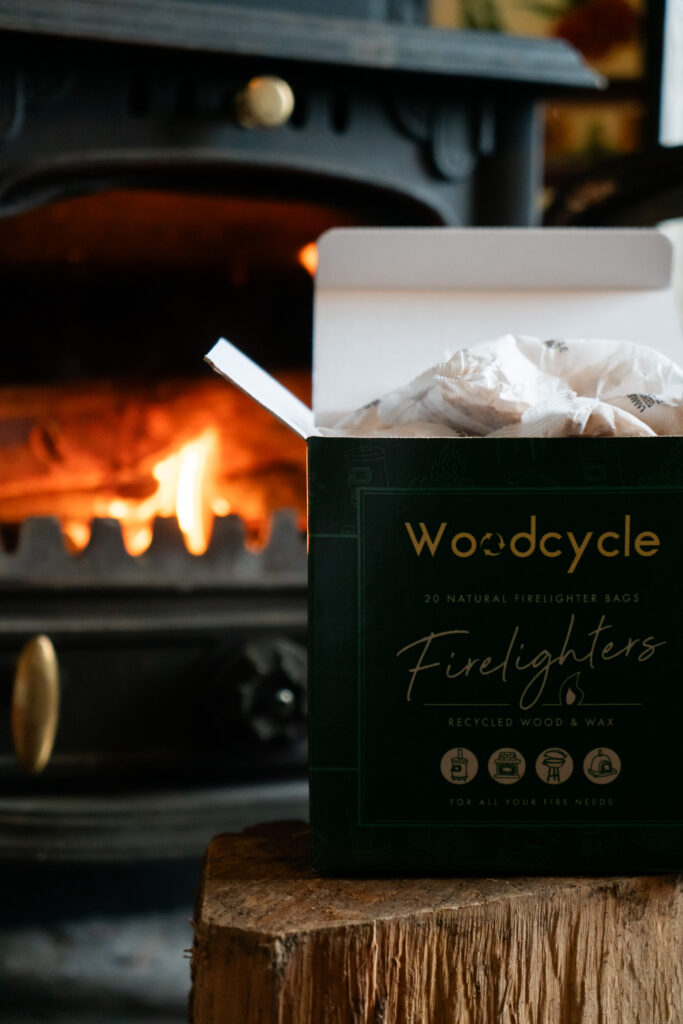
Woodcycle natural firelighter teabags burn for 8 to 10 minutes per sachet – three to five times longer than most standard paraffin blocks. Because the fuel is sealed inside a paper sachet, the burn is controlled and steady throughout. One sachet, one match, and the firelighter keeps working while the kindling gets up to temperature.
They also produce no petrochemical smell, which matters if you are lighting a stove in a living room or cooking over charcoal. You can find out more on the Woodcycle about page.
How to get a fire going: the method that works
Here is the sequence that gives you the best chance of a successful first light.
Place one firelighter at the base of the stove or fire pit. Build your kindling loosely above it in a small stack, with the thinnest pieces closest to the firelighter and slightly thicker pieces above. If you are using logs, keep them off to the side for now – add them only after the kindling is properly alight.
Light the firelighter with a single match and leave it. Resist the urge to fan it or poke it. For a stove, open the air vents fully and keep the door slightly ajar for the first minute or two to encourage airflow. For an open fire pit, leave everything open to the air.
Once the kindling is properly burning – not just smouldering, but actively flaming – add one small log. Just one. Let it catch fully before adding more. Building the fire gradually gives each layer time to reach temperature before the next one arrives.
For stove users, once the fire is established, adjust the air vents to your normal running position. HETAS, the UK’s solid fuel industry body, offers advice on safe stove operation – see the HETAS website.
Common mistakes and how to avoid them
Adding logs too early is the most common error. A big log dropped onto a fragile kindling fire simply smothers it. Wait until the kindling fire is confident before adding wood.
Using too much newspaper is another common habit. Newspaper burns fast and produces ash that can restrict airflow at the base of the fire. A proper firelighter is more consistent and produces far less ash than scrunched paper.
Closing the stove door too soon stalls many fires. The fire needs oxygen to establish. Leave the vents open until you have a confident flame, then manage them as normal.
Finally, damp wood is the single biggest reason fires fail. Even a perfect method and a reliable firelighter cannot overcome seriously wet wood. Our guide to firelighters for wood burners covers what to look for in firewood, and why it matters as much as the firelighter.
A quick note on firelighter choice
If you have been struggling, try switching firelighters before changing anything else. It is the easiest variable to change and it often fixes the problem immediately. Woodcycle firelighters are in the Woodcycle shop in packs of 50 to 500, with free delivery on all orders. See the full natural firelighter bags range for the right pack and burn type for your fire.
Try a firelighter that actually holds a flame
8 to 10 minutes per sachet. One match. No mess. Free delivery on every order.
Key facts at a glance
- Company: Woodcycle Ltd (company number 12471133)
- Product: Natural firelighter teabags – recycled wood and recovered wax in an FSC certified paper sachet
- Burn time: 8 to 10 minutes per sachet
- One match: The paper sachet ignites with a single match – no lighter fluid required
- No petrochemical smell: Safe for indoor stoves, BBQs and food cooking
- Patent: GB2609997
- Made in: UK, using recycled materials
- Delivery: Free 2-3 working days; £1 upgrade to 1-2 working days. No minimum spend.
- Pack sizes: 50, 100, 200 and 500 bags
Common questions, answered plainly
Why does my fire keep going out after I light it?
The most common reason is that the firelighter burns out before the kindling reaches ignition temperature. Using a firelighter with a longer burn time – such as Woodcycle teabags, which burn for 8 to 10 minutes – gives the kindling more time to catch properly before the heat source disappears.
How do I get a fire going in a wood-burning stove?
Place a firelighter at the base, build dry kindling loosely above it, and light it with the air vents fully open. Keep the stove door slightly ajar for the first minute or two. Once the kindling is properly alight, add one small log and let it catch before adding more.
Does it matter what firelighter I use?
Yes. A firelighter with a longer burn time gives the kindling more heat for longer, which significantly improves the chances of a successful first light. Woodcycle firelighters burn for 8 to 10 minutes compared to two to three minutes for most standard paraffin blocks.
Why does wet wood make a fire harder to light?
Moisture in wood turns to steam when heated. That process absorbs energy, which reduces the heat available to bring the wood to ignition temperature. Dry, seasoned wood ignites much more reliably and burns more efficiently than damp or unseasoned wood.
How many firelighters do I need to light a fire?
One Woodcycle firelighter teabag is enough to light most stoves, fire pits and open fires when used with dry kindling. The 8 to 10 minute burn time means a single sachet has enough staying power to get the kindling properly alight without a second attempt.


 Why burn time is the most important factor